Friday, 22 April 2016

Guadeloupe - a little French haven

We had 3 weeks to fill before the 49th Antigua Race Week, so decided to visit Guadeloupe for a bit of French culture - and baguettes.  The island was initially the home of the Carib people who successfully repelled the attempts of the early Spanish colonisers in the late 1400's, but 100 years later they were not so lucky against the French who took over the island.  The English made many attempts to take it from the French, but despite a couple of brief periods of British rule and endless Anglo French skirmishes over the next 200 years, Guadeloupe is part of France and has been a full French Departement since 1946.

We went to Deshaies on the north west of the island - a beautiful bay, crystal clear water and a quaint little town with a couple of mini markets and plenty of cafes and restaurants.


Deshaies bay, as seen from the interestingly rustic dinghy pontoon.

Although small, Deshaies had three dive schools - inspired by the excellent snorkelling at the sides of the bay, we checked them out and booked a couple of dives with Tropical Sub - we enjoyed the dive so much that we ended up doing the PADI Advanced Open Water with them which really was excellent.  We opted to include a night dive as well as a trip to Pidgeon Island, the Jacques Cousteau Marine Reserve which is about 10 miles south of Deshaies.


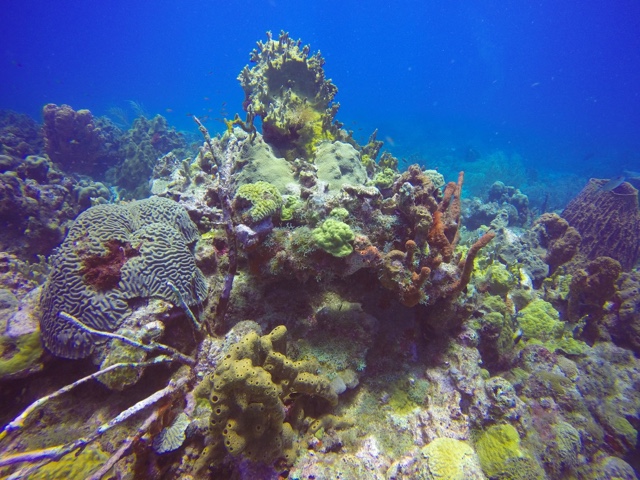
The Cousteau Reserve - the water really was like an aquarium.


The Lion Fish, an invasive species that has no predators in these waters, and because it's a reserve, they can not be hunted as in the other islands.  They do look spectacular though.


The Trunk Fish - my personal favourite.


And a Hawksbill Turtle - everyone's favourite!


The Great Man himself - Jacques Cousteau.  There are various rumours surrounding the missing hand - apparently it may have been hooked by a yacht anchoring illegally, picked up by the Underwater Gendarmes who allegedly patrol and give €150 fines to divers who touch anything living underwater, and now the Marine Reserve, Dive Schools and Gendarmes can't agree on who should lift the statue to replace the hand.  

Despite spending so much time under water, we did manage to visit the Deshaies Botanical Garden - a 20 minute walk up a steep hill, but certainly worth the effort.


A selection of the flowering plants, and a hummingbird


The Travellers' Palm - apparently you can always find a drink of water at the base of the leaves, not too sure how easy it would be to get up there and drink it though.


Some really big trees with buttress roots


And a peacock doing a fine job of herding flamingoes.

Being part of France, Guadeloupe has a great selection of walking paths - we took one from Deshaies over the hill to Grande Anse d'Arlet, the absolute epitome of a Caribbean Beach.


The view down through the trees to Grande Anse D'Arlet.  Apparently the setting for the uk  TV series Death in Paradise.
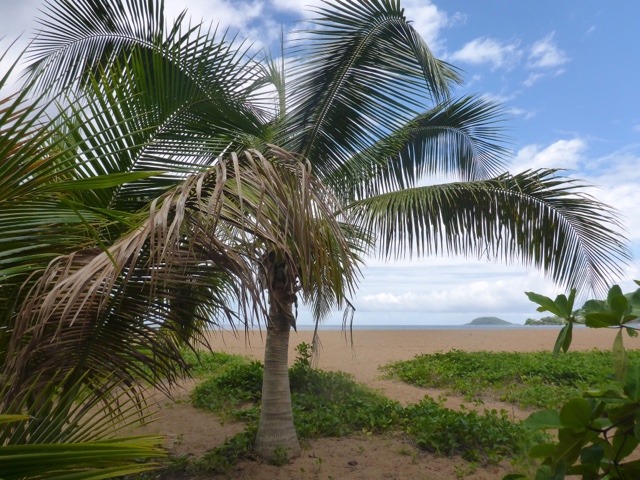


It certainly is a paradise.

Although we loved Deshaies we felt we needed to see another part of Guadeloupe so we set off south to the Iles des Saintes - and it was fabulous.


Iles des Saintes - we are on one of the mooring buoys in the distance.


The high street - you can rent a golf buggy here to tour the island.


An absolute highlight - the Doctors' Surgery!  I think he'd rather be at sea.

As usual on the islands, there was evidence of the old Anglo French Hostilities.  The bay is overlooked by Fort Napoleon from one side, so we set off to have a look round.


The view from the top - Cabrits Island is on the far right, and the Pain de Sucre rock is at the tip of the main island.


Fort Napoleon.  Originally known as Fort Louis, it was destroyed during one of the many Anglo French battles and reborn as Fort Napoleon - by that time hostilities had ceased, so this building has never seen active service.

Back on the water, the Pelicans  were a source of constant entertainment.


This one is going for a gentle landing, but you would not want to be in the way when they dive for fish!

There are three mooring areas, we spent two days by the town then headed round to the Pain de Sucre bay - a very peaceful spot.


And a good place to admire the sunset.

Our last stop in the Iles des Saintes was Cabrits Island - the mooring was not as comfortable as there was quite a swell but again it was beautiful and gave us an opportunity to walk up to Fort Josephine - which had seen active service!


Looking back towards the main island from Fort Josephine, with the Pain de Sucre visible on the right.


The remains of the fort - currently home to lots of goats.


View from the Fort - Nautilus visible in the gap on the Isle de Cabrits mooring.

So after a couple of wonderful weeks in Guadeloupe, and a final sunset in the Saintes, and then it's back to Antigua for the race week next.


Saturday, 26 March 2016

Antigua and Barbuda

We sailed directly from Dominica to Antigua, setting off at mid day and sailing overnight to ensure we arrived at our destination in full daylight.  Our first stop was Falmouth Harbour on the South of the island, a very well protected inlet and a 5 minute walk from English Harbour - famous for its 18C Nelson's Dockyard.


Nelsons Motivational Message!  As flown before the Battle of Trafalgar, displayed here in the Dockyard Museum.

The island was first discovered by Columbus in 1493 and then colonised by the British some 150 years later. They cultivated the island mainly with sugarcane which involved importing vast numbers of slaves and deforesting the island. The prosperity of the sugar trade led to the construction of fortifications, most notably Nelsons Dockyard in English Harbour.


Nelsons Dockyard


The restored Sail lofts.


The view down over the harbours - Falmouth on the left, English on the right, separated by a narrow strip of land


The view over the entrance to English Harbour - very well sheltered.

Shirley Heights fortification overlooks both harbours and now hosts a bi-weekly BBQ with traditional steel band - well worth the 40 minute walk up from the harbour,although after a few rum punches we did take a taxi back down.


English Harbour in the foreground, Falmouth in the distance.


Again from Shirley heights, the lit spreaders of the Super Yachts can be seen in English Harbour below.

My sister Rose Anne came to visit us in Antigua, after a couple of days in Falmouth Harbour we set off up the west coast to Jolly Harbour - again wonderfully sheltered.


Jolly Harbour in the distance, photo courtesy of Rebell as we didn't walk that far!


Sunset in Jolly Harbour Anchorage.


There is a large marina and several holiday complexes here, but from a sailors perspective the best thing about the place is the supermarket - it may be a bit pricey (but everything on Antigua is), but it is very well stocked.

So - shopping done, we set off to the island of Barbuda where there is nothing apart from sand, frigate birds and beaches.

Barbuda is about 13 miles by 7 miles, it is basically a sand dune (the highest point is 39 metres) surrounded by reefs and coral heads - it's so low lying that you have almost arrived by the time you see land.

We anchored in Cocoa Bay - on the South West tip of the island.


We were escorted in by Dolphins, we had to wait for them to move when we wanted to drop the anchor - certainly a first for us!


Cocoa Bay anchorage


Cocoa Beach - 5 miles of sand.

The main attraction on the island is the Frigate Bird Sanctuary in the enormous inland sea on the north west side of the island.


Where ever you are in the Caribbean there seems to be a Taxi Driver asking if you want a ride - fortunately Barbuda was no exception and we were driven along a dirt road to the southern end of the lagoon where we were to take a skiff to the birds.


Prior to the import of cars on the island, transport was by donkey.  Once they were no longer needed it seems people left them to roam and they certainly appear to thrive on the island.  Our taxi driver told us they outnumber the humans on the island - fairly impressive, even though there are only 1,800 inhabitants.


The main Airport - there are actually two on the island, again as a result of the poor roads as it used to be easier to fly than drive from one end to the other.

There are some exclusive gated holiday complexes on Barbuda, but there are also several that have suffered either from hurricanes or economics.


Hurricane damaged hotel, with no sign of any plans to repair it.


Our taxi driver and self appointed font of all knowledge advised us that this holiday complex had been weeks from opening when it was suddenly abandoned.  


Cordington Lagoon - awaiting our transport - at 115 hp, it was a fast and very bone jarring trip.


The Lagoon is 5 miles long and very shallow.  


It was certainly worth it:  There were literally thousands of them. Frigate Birds are huge, with a wing span of up to 2.3 metres - they breed at any time of year, and the chicks are fed with regurgitated fish for the first 3 months by both parents then only the mother for another 6 months.  


The Magnificent Frigate Bird.  Males are black, females are paler and have a white head.


A young chick on the nest.


A male - doing its best to attract a mate with its fully inflated throat sac.


Despite being pelagic, Frigate Birds can't dive or land on water as they are not able to take off again and do not have oily waterproof feathers so they feed in flight.  At sea they catch flying fish that are disturbed by tuna and other top predators - a drop in fish stocks would impact heavily on these birds.

They also feed on jelly fish, which was just as well as the lagoon was full of them.


Our guide / boat driver picked these two off the bottom, apparently they don't sting!

After a couple of days in Barbuda we headed back down to Antigua - 30 miles, a 6 hour hard beat into a fairly large sea.  We went to Green Island on the south east of Antigua - another beautiful spot, no Dolphins this time, but plenty of green turtles instead.


A green turtle in the anchorage at Green Island.


Green Island.  Very well protected from the swell by a surrounding reef.


And finally we were somewhere sheltered enough to get the paddleboards out.

After a couple of nights We left Green Island and headed on round Antigua, past English Harbour and on to Jolly Harbour where my sister had to leave us to go back to 'real life' - we had had a great week, plenty of swimming and snorkelling, turtles, pelicans, frigate birds and dolphins plus  a sail round Antigua and a quick trip to Barbuda.  Could almost have been a Charter holiday!


Brown Pelicans.

Having spent some time in the Caribbean, you can not fail to notice the huge numbers of dead and dying coconut palms.  


The problem is caused by the disease Coconut Lethal Yellowing Phytoplasma which is spread by a plant hopper that lays its eggs in heavy grasses, and is thought to have arrived on infected grass seed imported from Florida used for parks and golf courses.  The leaves yellow and the palm will be dead within 6 months of becoming infected.  Whilst it doesn't affect trees grown on sand, it is still decimating the palms and posing a threat to the Coconut growers' economy.

We have enjoyed Antigua, which is just as well as we will be back here in less than a month for Antigua Race Week - until then, our plans are uncertain.