Sunday, 5 August 2018

Fiji - The Coral Coast, Viti Levu to Musket Cove


Nautilus at anchor in Vatulele Lagoon

Fiji is a volcanic archipelago of over 330 islands and hundreds more islets - home to nearly 900,000 people, 90% of the population live on one of the two main islands (Viti Levu and Vanua Levu to the north). The ethnic Fijians were proudly cannibalistic - a deterant to many early visitors - the traditional greeting for a commoner to a Chief was apparently “Eat Me”.  

Fiji became a British Colony in 1874, and it was the British who brought in the Indian workers for their plantations resulting in two distinct cultural groups - the Ethnic Fijians and a minority of Indo-Fijians.  Despite efforts to unite the two groups, there is still conflict at times and only Ethnic Fijians may be referred to simpoyt as Fijians.

Having checked in at Suva on Viti Levu we bought some fresh provisions from the huge market - there were literally hundreds of individual stalls, mainly selling the same locally grown produce plus a few with imported New Zealand apples and oranges.


One of the outside stalls that surround the covered market - there are tarpaulins overhead, but when it rains the preferred means of keeping your head dry is to use a plastic bag.  We bought pomelos (giant sweet grapefruit) and cucumbers from this lady for a couple of Fiji $.


The produce is sorted into piles, each pile for a fixed price - it is a very simple, no haggling approach to shopping.  The locals are incredibly friendly and have all been very happy to have their photo taken.


Eggs, spices, dried produce and Cava are all available in the covered area of the market.

Suva is a town of many contrasts - as well as the traditional produce market and crafts market, there are also large modern shopping malls and huge supermarkets.  We completed our provisioning at the giant Cost-U-Less and headed out to the islands.

Our fist stop was Beqa, just south of Viti Levu where we entered the lagoon and and had a close encounter with a humpback whale ... no photos, but it surfaced literally 10 metres in front of us.  Fortunately we didn’t make contact, but it certainly was close enough to give the helm (and presumably the whale) quite a shock!

We anchored in Vaga bay and headed ashore with Hugh and Annie to present our first Savusavu at the little village.  We wore Sulas (Fijian sarongs), covered our shoulders and removed hats and sunglasses as required by local custom and were taken by the Mayor to meet the Chief.  The Mayor presided over a short ceremony, our gifts of Cava roots were gratefully received and we were given permission to wander around the village, swim in the bay and walk inland.


The Mayor on the left, then Annie from S/Y Vega next to the Chief’s Wife.  Ian is sitting next to the Chief in his house.


The local’s houses are almost always constructed of corrugated iron, there are well tended crops and always lots of laundry drying on the line.  We walked up the hill for a view over the bay - a nice walk but the view was mostly obscured by the lush vegetation.  That afternoon one of the locals took us all out in his boat to dive on the wreck of a large fishing boat in the bay.


The primary school children are educated in a nearby larger village, but the secondary school requires a boat trip.  As usual, the children were immaculately dressed in their school uniforms.


After a couple of days in Beqa we waved goodbye to Hugh and Annie from Vega and headed on to Vatulele island where we met up with yachts Jadean and So What who we cruised with last year.  Again, Savusavu was required - Barry, Greg and Ian set off by dinghy to the village round the other side of the island from our anchorage bearing the customary bundles of Cava Roots.


Although the Navionics charts are fairly accurate in these waters, like many cruisers we also use satellite images - this shows the island and the surrounding reef on Vatulele.  We anchored off the north west coast between the two beaches, you can see the village on the north east coast, and also the run way which is now disused and overgrown following a cyclone that destroyed the resort here some years ago.


The cyclone not only destroyed a coastal walkway and damaged many of the resort villas, it also pushed the resort’s cruise ship, the ‘Reef Escape’ onto the beach - where it remains, gradually rusting away on the sand.  Apparently the resort is under new ownership and will be renovated but the ship will probably stay where it is.

The coastline and surrounding reef are beautiful.


We met a family collecting edible sea weed at low tide.  


Not too sure how much help the kids were, but they were having a good time!  The next day was Sunday so we walked across the island to church - Fijians are deeply religious, we attended the second of the three Sunday services, a Methodist service, conducted in Fijian.  Although we couldn’t understand a word of it, the singing was wonderful and the concept of the Wrath of God came across loud and clear! 

We were then invited to the Minister’s house for lunch, with food provided by various of the village families - we ate sitting on a large woven mat on the floor, visitors and the minister first and once we had finished his wife ate on her own.  We were given chicken noodle soup, yam, smoked fish in coconut and interestingly a dish made from the sea weed we had seen collected the day before - also served in coconut milk but with added chilli and smoked fish.

We learned that the sermon was on the evils of drugs and incest, and the importance of education.

The villagers were all in their Sunday best, and despite attending three church services in one day the 100 or so children were beautifully behaved.


Indo-Fijians and Fijians children clutching their Fijian language bibles played happily together outside the church after the second service before setting off home for a meal and rest before the final service of the day.

We left for Musket Cove the following day, one of the major tourist resorts, but also an area reputed to have excellent diving.

One final image - the airport waiting room, next to the disused and over grown airstrip - no longer used since the closure of the Vatulele Island Resort some years earlier.


Next stop - Musket Cove and Fiji Underwater


Saturday, 21 July 2018

Finally left New Zealand!


En route for Fiji


We arrived back in New Zealand and found Nautilus safely where we’d left her in the long term storage at Port Whangarei Boat Yard - covered in dirt and a bit mouldy but nothing a good scrub wouldn’t sort out.

We had a few boat projects before we went back in the water - a new dinghy davit system for our smart new RIB, a dive compressor housing and the solid spray hood.  The dinghy davits we’re done within the week:  No more building the PortaBote to go ashore!


The dive compressor housing took a bit longer - it had to be painted, and have a new table top made.  Once it was in place you could hardly imaging it held a compressor.


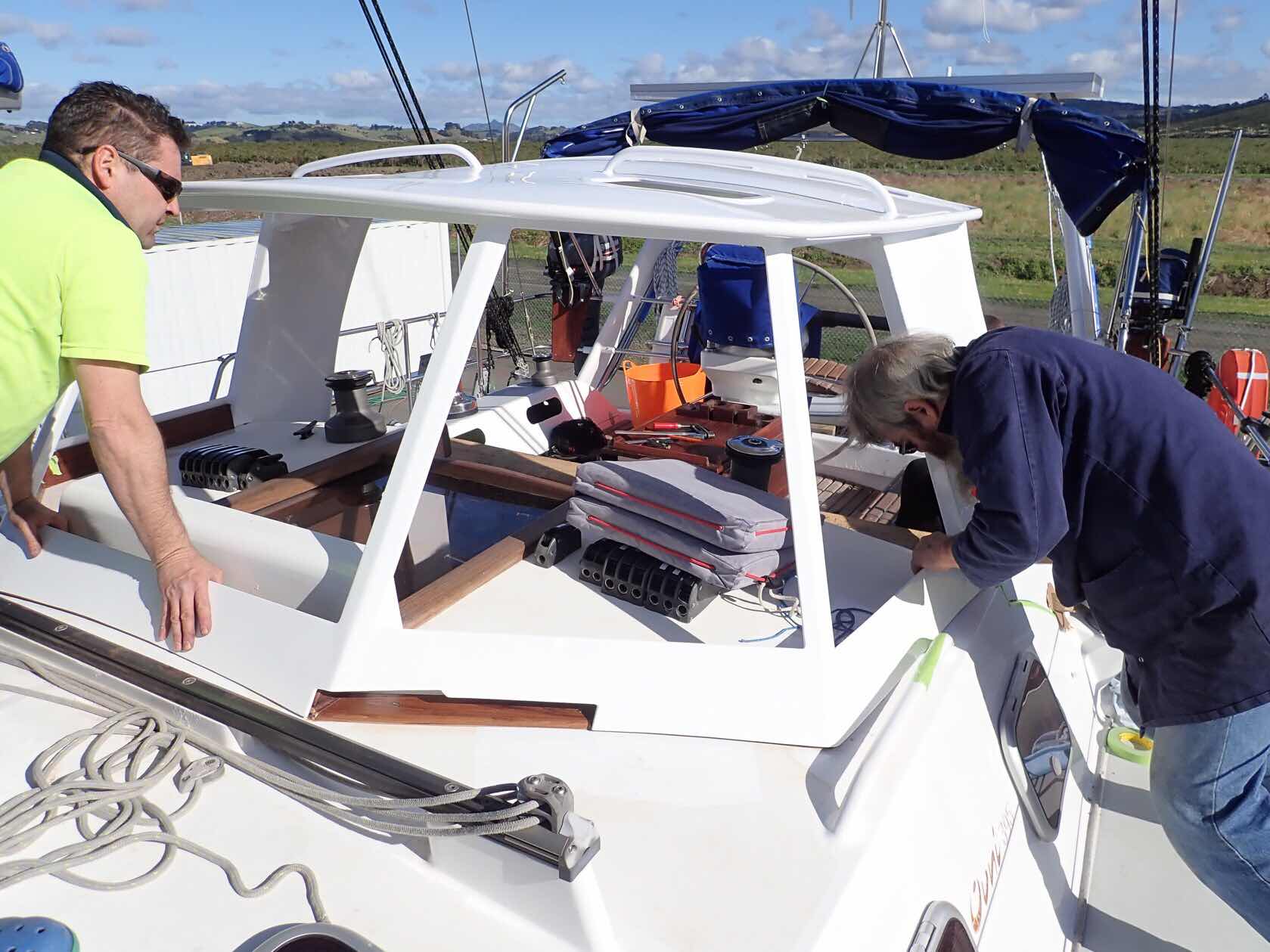
The sprayhood took much longer - built from scratch, we can not fault the team from Northern Marine Machining - other than, perhaps, their optimism in believing they could complete the project in 12 days!!  


The final project took 2 months - we are fortunately very pleased with the results!  Having toughened glass windows instead of plastic sheeting should mean a huge improvement in visibility from the cockpit, the height is such that we can stand underneath it and there are integral handles for added safety when moving around the boat.

The countryside around Whangarei, North Island is beautiful - we did many of the walks around Whangarei Heights as light relief from being stuck in the boatyard.


We never saw the elusive Kiwi Bird, but we did see some fantastic Kauri trees - the Department of Environment works hard to prevent the spread of disease to these trees, there are antiseptic foot baths and brushes provided for use before you enter the forest paths.


Kauri Trees

We certainly had plenty of time on our hands to get the boat ready!


Dressed for anti fouling the boat.


And finally in the hoist - ready to go back in the water and head for the warmer waters of Fiji.  We are next to the race yacht Poseidon, a splendid sight with a 4m keel the yacht used to belong to Dennis Connor of America’s Cup fame.


Dion and Doug - the Hoist Operators were a ray of sunshine in Port Whangarei Boat Yard - lower us back into the water.

We completed the New Zealand Exit Formalities with Customs at Marsden Cove and set off on a blustery morning for Fiji - the weather threw just about everything it had at us:  Torrential rain, huge squalls, winds over 30 Kts for at least 12 hours with a peak gust of 48 Kts, huge commercial fishing boats erratically changing direction in front of us ... and moments of blissful sailing.

We sailed for several days in winds stronger than any we have experienced so far - and it’s always at night when conditions get really challenging!  We were really quite relieved to find we still had a dinghy (stored on the foredeck during long passages so that we can use the self steering equipment on the back of the boat), and also that nothing (including us) got damaged during the crossing.  

9 days and 1144 nautical miles later we arrived in Fiji - by then we were well into the routine and considering the conditions we’d experienced, quite well rested!  


We had time to do some fishing - we had fish for lunch and dinner for 4 days from this Mahi Mahi.


First sight of land, and our last night of the passage - we are passing Kadavu Island, but unable to stop as we are obliged to first clear Customs and obtain a Cruising Permit from Suva before we can visit the islands.

Once we had been boarded by Health Officers and deemed safe, Biosecurity and Customs came aboard - the next day we had to go into town to pay our dues and collect our Cruising Permit.  We are now free to visit the Islands of Fiji.


First stop:  The huge Municipal Market to buy some Cava Roots to present as gifts to the island chiefs for the traditional Savusavu ceremonies.

We have caught up with our friends Hugh and Annie here in Suva, and later on we will be meeting up with Kim and Barry as well - and then it’s on to the islands!


Sunday, 26 November 2017

We have arrived in New Zealand!

With the Pacific Cyclone season approaching, we needed to be in New Zealand by the beginning of November so cut short our stay in Tonga.  A three day passage took us to North Minerva Reef, a last opportunity to anchor in an atoll for the time being.  Minerva Reef  consists of  two separate reefs, North and South, both are awash at high water - there is one pass into the lagoon, and at high tide all you can see are the waves crashing on the outer rim of the reef - and the lighthouse, which is a rather unusual sight on an atoll hundreds of miles from anywhere in the middle of the Pacific!


Minerva Reef was named after the first of several whaling ships to be shipwrecked there in the 1820’s.  It has an interesting history - in the early 1970’s an American millionaire attempted to create a Tax Free Sovereign Micro-nation on the reef, allegedly he had a budget of $100 million, barges of sand arrived from Australia in an attempt to create dry land.  The surrounding Pacific Nations did not approve - Tonga was officially handed all rights to Minerva Reef.  Undeterred by the first failure, another group of Americans attempted to occupy the reef in 1982 and were rebuffed by the Tongans.  All was peaceful until 2005 when Fiji decided to have a go.  In 2010 they blew up the lighthouse - the Tongans rebuilt it - the Fijians blew it up again - the Tongans rebuilt it and proposed a trade off with Fiji’s L’au group of islands for Minerva Reef.  The debate continues!


The remnants of a previous lighthouse on the North Minerva Reef - Nautilus is one of the yachts in the background.


Minerva Reef at low water.


Waves crashing onto the reef on the windward side of the atoll.  This is all covered at high water.


Minerva makes a very convenient stopping over spot for yachts between Tonga and New Zealand - we were joined there by Hugh and Annie from Vega, as well as Rito and Angela from SheSan,  and Pele and  Ulla from Loupan.  Along with Rick and Amanda on Duplicat, we ended up spending several days sheltering there from some very strong winds before we set off on the final push to New Zealand.  The diving on the outer wall of the reef was absolutely spectacular - fantastic coral canyons and a drop off that almost gave you vertigo.  Unfortunately due to the strong winds we were only able to do the dive once, with Rick.

Finally there was a break in the weather and we set off for New Zealand - a 915 nm trip.  Having waited out the strong winds in the lagoon, we ended up motoring for 3 full days of the 7 day trip.  It did however give us plenty of opportunity to sort out the boat in preparation for clearing into New Zealand.  New Zealand makes great efforts to protect its agriculture and wildlife, and for that reason no eggs, plants, seeds, uncooked fruit or vegetables or meat that is not tinned can be brought into the islands.  


Ian was not at all upset to be chucking the last of our dried beans and pulses overboard before arriving in New Zealand!


Our instruments record the Longitude as we cross the Prime Meridian from West to East - we have sailed half way round the world!


Our final Pacific Sunset before reaching New Zealand


Superbe sailing conditions (although rather chilly!) as we head for Opua, New Zealand.  We even had a pod of whales guide us in to the bay.

We completed the paperwork formalities in Opua and spent several days in the marina before heading on down to Port Whangerei for a haul out and some repairs - sorting out the welding from the damage we sustained in Panama being one of the essential jobs on the list.


Nautilus dwarfed by the 100 ton Travel Hoist, she only weighs 12 tons.


Andre from Industrial Rebuilds Ltd cutting out the damaged area of the hull.  It’s never relaxing watching someone with an angle grinder working on your boat.


Job Done!  The corner of the transom fully repaired and the fuel locker at the back enclosed by Andre of Industrial Rebuilds Ltd and new extended stainless steel guard rails built and fitted by Mark from Northern Marine Machining.  We could highly recommend both of these companies to carry out boat works.


And finally - our route to New Zealand


The statistics so far ...

Total miles sailed since leaving the UK:    26,423nm
Miles sailed in 2017:                                    9,195nm
Nights spent at sea in 2017:                        55 nights
Longest single passage in 2017:                 24 days, Galapagos to Marquesas.  3033 nm 
Number of Countries visited in 2017:        11     (Dutch Antilles, Columbia, Panama, Galapagos, Marquesas, Tuamotos, Society Islands, Cook Islands,
                                                                              Niue, Tonga, New Zealand)


So now the boat is out of the water, sails and ropes washed and removed.  We will be leaving her here for several months and heading home via South Island, catching up with friends and family and finally experiencing a winter again!  We plan to return here at the start of the Southern Hemisphere winter, a few more things to sort out on the boat and then hopefully Fiji and maybe back to Minerva Reef and Tonga in 2018.  This blog only covers sailing, so will be on hold now until we’re back on the water.