The Hibiscus and Poinsettia Rigs are on the rum line between the south of Grenada and the North West of Trinidad - exactly where we want to be!
We sailed peacefully overnight, but when we were approximately 10 Nm from Trinidad one of our group, the yacht Enterprise, was approached by three men in a pirogue - their actual intention was unclear, but by all accounts it was not friendly. Luckily no harm was done, but not at all pleasant none the less and certainly a good illustration of the importance of maintaining radio contact and sailing in company.
As you approach the coast of Trinidad, the water becomes very dark brown, stained by the run off from the Orinoco Delta in Venezuela which flows northwards up the Venezuelan coast.

We are heading between the islands off the North West coast of Trinidad - there is a very strong current, and the water is a very dark brown colour.
Trinidad was originally the home of South American Indians, but like much of the Caribbean it was invaded and colonised by the Spanish, French and British, bringing African and Indian slaves to work on the Cocoa, Coffee and Sugar plantations. The Americans established a vast Naval Base in Chaguaramas in WW II, and in 1962 Trinidad & Tobago finally obtained independence from the British to become the very multicultural two island state it is today.
Chaguaramas continues to be an industrial port - not a place you visit for the scenery!

A huge dry dock in the entrance to the harbour where ships can easily be lifted for maintenance.

Not only is the water in Chaguaramas bay an unattractive colour, it is very definitely full of rubbish and in our brief experience here regular oil and diesel spills.

Chaguaramas bay looking it's best at sunrise.
Trinidad and Tobago are considered to be safe from Hurricanes, and for that reason there is a large marine industry here, with 4 marinas and huge yacht storage and repair facilities - it has a reputation for being the place to come for good quality work. In the event, we can say first hand that it lives up to its reputation: Our battery charger, a fairly essential piece of kit, suddenly failed and we received excellent service from Jesse Gangasingh of Caribbean Marine Electrical Limited in Powerboats Marina. The charger was removed, tested and replaced within 24 hours of the problem commencing.

Powerboats Marina, pelicans are waiting for scraps as two fishermen clean black tipped shark.

A pelican awaiting a snack
The popluation of Trinidad is about 1.3 million, and Port of Spain is the Capital. We took a bus which cost TT$5 (about £0.75) to investigate what the city had to offer.

The rules displayed on the bus window.

Our first trip to the city was curtailed by the rain - a very heavy tropical downpour.

After the rain - much of the town was flooded, but no one seemed worried and we assumed this was a fairly regular occurance. On a subsequent visit we did manage to get to the Botanic Garden which dates back to 1820, and also went past Trinidad's version of the Sydney Opera House.

The National Academy for the Performinig Arts - quite a contrast to many of the other buildings in Port of Spain.
As well as literally miles of street stalls selling fruit and vegetables, Port of Spain is well known as a place to buy fabric - I have never seen shops like this before.

Anything you need for your Carnival costume, or to reupholster your car, or replace your curtains you will certainly find in one of these shops.
Our next outing was The Taste of Trini Tour, organised by Jesse James who seems to be a one man tourist board for the Criusing Community. We set off in his mini van along with Steve and Lynne from Aztec Dream, Russ and Anne from Enterprise and Simon and Jenny from Fenicia and an Australian couple to literally eat our way round Trinidad.

A Doubles Van

One of the most traditional breakfasts - Doubles. Curried chickpeas served in two pieces of fried flatbread. Absolutely delicious, and very hard to eat neatly!

Roti - more fried flatbread, this time filled with curried goat, chicken, fish, beef or vegetables as well as chickpeas. Again delicious, but huge, and again not part of a low fat diet!

And for lunch - Buss Up, a sort of deconstructed Roti with extra vegetables. Lovely.

More fried food, this time Saheena, a spicy swirl of Calaloo (Calaloo is the leaf, and dasheen the root which is boiled and used much like a potato in many dishes), with a paste made from yellow split peas and of course hot sauce. And guess what - delicious!

Pickled fruit - we tried several, surprising probably best describes it, unripe fruit 'pickled' in chilli and various other hot spices. At least it wasn't fried.
And the ones I wouldn't even try ...

Cow Heel Soup

Chicken Foot Souse - here being devoured by Jesse himself. Apparently it's very nice.
One of the most interesting things we came across was the Brazil Nut, the nuts themselves are the seeds in a large, heavy outer pod


Editors Note:
The Brazil Nut pod.
When the nuts are ripe, the lid of the pod opens itself and the nuts can easily be removed or fall out. Initially the nuts are soft and easy to open but the shell then hardens into the very hard more triangular shaped nut we see in the shops in the UK.
Apart from eating, our Taste of Trini Tour took us to some beautiful parts of the island on the Atlantic Coast - it looks like the archetypical Caribbean scene, complete with miles of coconut palms.
Manzanilla Bay, the Atlantic coast of Trinidad.
On this coast you can see clear evidence of the rising sea level - buildings have been washed away, and these are the stumps and roots of palm trees
Where the river meets the sea at Manzanilla.
An outing of rather less universal appeal was to the Pitch Lake - right on the South Western tip of Trinidad. Apparently Noel Coward described it as "22 tennis courts badly in need of repair" and he did have a point. Beautiful it was not, but it certainly was extraordinary - it is a natural 'lake' of 10 million tonnes of asphalt, partially covered in sulphur pools.
If you stand still too long you will sink into it.
Our guide showing us part of "The Mother of the Lake' where the pitch is really soft - we were shown a photo of a local lad who went for a walk without a guide and sank up to his shoulders. Luckily his girlfriend managed to get help and he was pulled to safety.
The sulphurous water is supposedly good for you, and there were groups of locals enjoying the benefits while we were there.
Our trip to the Pitch Lake also took us to an Indian Ashram, a very ornate temple, often described as a "wedding cake".
This is the largest statue of the Hindu God, Lord Hanuman outside India, and is 85ft tall.
Port of Spain has a very large weekly market, apparently the stall holders start setting up at midnight, but we got there at about 0700 and it was in full swing ...
Chilli Peppers and the milder Flavour Peppers as far as the eye can see.
The bundled stems with large leaves on the right are Calaloo - and yet more peppers.
Wonderful avocados. The exchange rate is about TT$8 to £1, so although they are not the cheapest fruit available they are huge and very tasty. There were loads of other vegetables as well as spices and sauces
And some of the less appealing items for sale ...
Land Crabs, you eat the legs and claws
For those who wish to make Cow Heel Soup maybe?
Pigs tails and snouts
Nothing is wasted
And I certainly would not use one of their shopping trolleys here, as you know what's been in it!
Our final outing in Trinidad has been a Nature Trek with wildlife guide Emile Serrette. He loves the mountains and loves his job - he was an excellent guide and took us to some waterfalls deep in the forest.
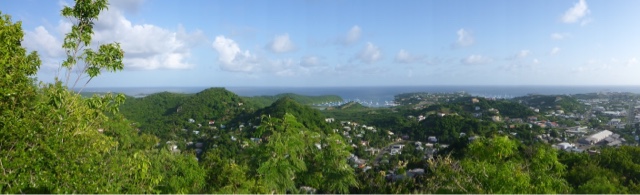
Like many Tobagans he loves his country and stopped to show us some wonderful views on the way to the Trek on the North of the Island. This is Saut D'Eau, with Venezuela just visible in the distance.
La Vache bay - where it looks as if it might be raining.
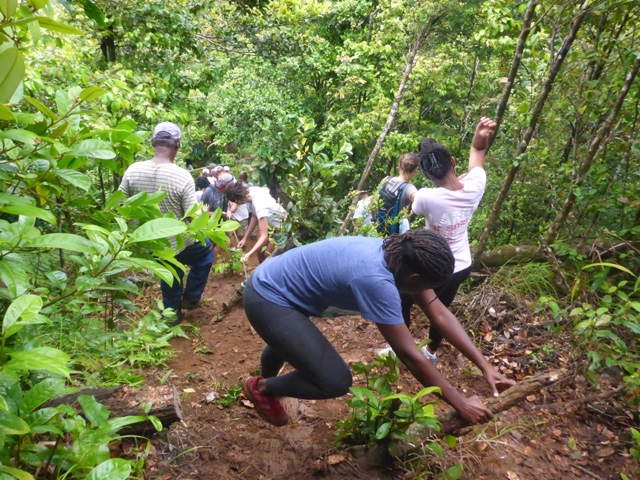
We follow Emile into the forest - you can certainly see why you need a guide, and on several occasions we also saw why he needed to carry a large Machette knife.
Monkey Ladder Vines
One of the many trees we encountered on the trail.
Our first destination - Habio Falls
The perfect place for a quick, refreshing swim
And a very high pressure shower.
Changing into swimwear for the swim was pointless - being a rain forest, it started to rain, and within a few minutes we were literally soaked to the skin.
Emile led us deep into the forest, up and down some very impressive gradients - and still it rained!
Waterfall number two - Churro Falls, even more impressive than Habio.
This time we didn't even bother to change, just jumped straight in as we could not have been any wetter.
After about 5 hours hiking and an hour or so at the various waterfalls and pools we finished our hike and Emile took us to Maracas bay on the North coast for another Trinidad speciality, and one we had not experienced on our Taste of Trini day - Shark and Bake.
Although it should really be called Shark and Fry, Shark and Bake is shark meat deep fried in very highly flavoured batter served in a bun which is a bit like ciabatta, but fried, of course. You then choose froma large selection of sauces - some are hot and spicy, some garlic, some herbs - and if you still have room you can add some salad as well. And yet again, absolutely delicious. Just as well we'll be leaving soon!
The only thing conspicuously absent from our visit to Trinidad has been the music of Steel Drums, or Pans as they are called here. Considering this is the home of the steel drum, and the Pan is the national instrument of Trinidad and Tobago, it's surprising that we have neither seen nor heard them at all.
We have had a very busy two weeks here, and our plan is to head for Tobago where the sea is a lovely Caribbean blue and the diving is reputed to be fantastic before we head on South to Guyana and French Guyana with the Nereids Rally at the beginning of September.
Steve (from Aztec Dream) and I have been playing pool or table tennis is every Caribbean Island we have visited so far. The tables have finally turned and Steve has captured Trinidad. He obviously gets better the further South we get. Not sure what we will find in Guyana and French Guyana but the contest will still continue.....and who knows what we will find in the Pacific!